I am an experience strategist. I came to design practice from poetry and sociology, disciplines interested in what people feel, and why. I was trained first to see what a situation is really organizing beneath its surface, and then to find the form that makes invisible things felt.
Both turned out to be essential to the kind of work I care most about: designing the emotional and relational situations that a product or system can invite in a human life.
The work has taken many forms. A pizza tracker that made waiting feel like watching. A connected vehicle that asked what a car might notice about your life beyond the road. Patient experience work that asked how the system around treatment could support healing. These are different projects. What they share is a question: what does this system understand about the person using it?
I am particularly interested in adaptive, always-on systems: connected vehicles, AI platforms, ambient environments, health technologies. Not as engineering problems. As design spaces where the relationship between people and technology is still being decided.
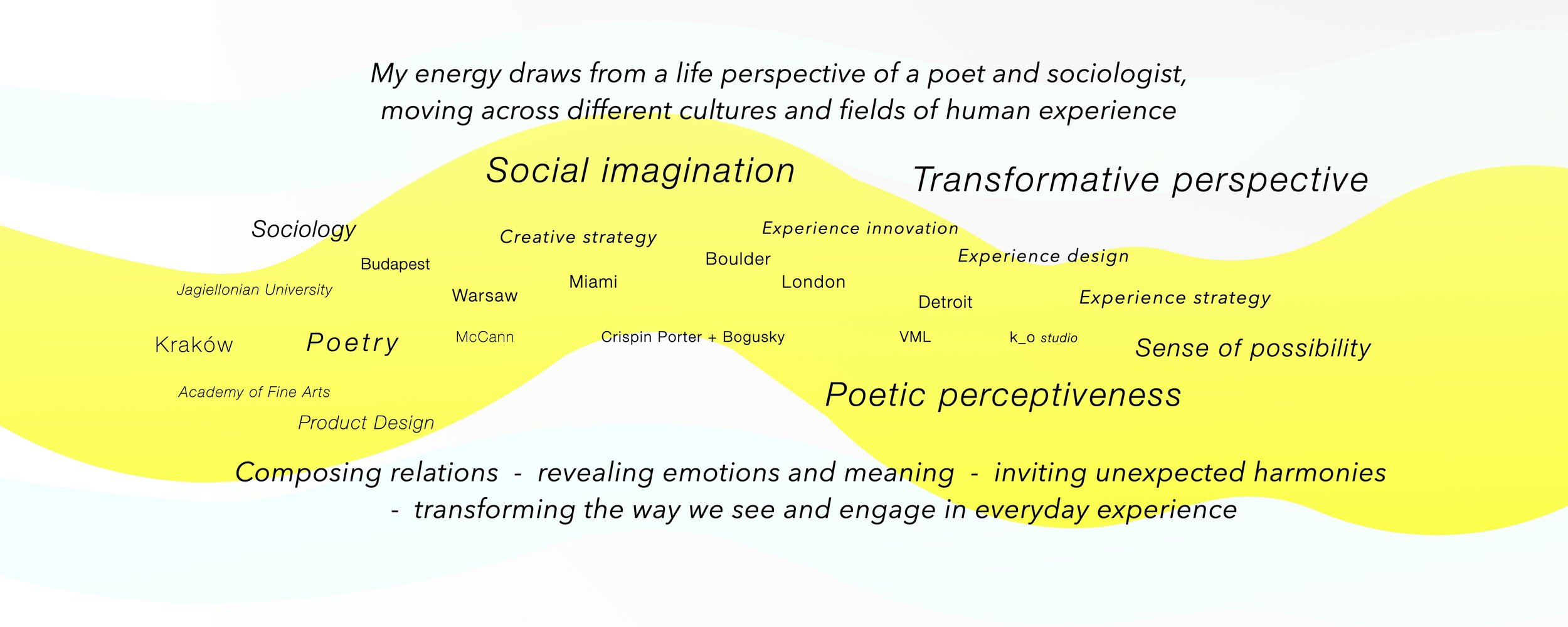
I moved between disciplines and creative roles exploring the frame that organizes all of them: social imagination — the ability to see the relational and emotional surplus in any product or system, and design toward it with rigor and intention.
I’ve spent my career building that practice across institutions and disciplines. At CP+B, where I found eleven years of discovery, I created Room for More Possibilities — a strategic invention unit at the edge of what connected technology could become.
At VML, I built Kinetic Optimism studio in partnership with Ford Product Development, spending seven years designing the experiential architecture of connected and software-defined vehicles. Along the way: a US patent, multiple patent disclosures, a body of original design philosophy, and work across healthcare, mobility, connected services, and the social life of objects for the kind of world I have hope to live in.
Clients have included Domino’s, Ford, Lincoln, Mazda, Volkswagen, AstraZeneca, Merck, J&J, OnStar, Hotels.com, American Express, IKEA, Kraft, Virgin Atlantic, United Rentals.
I am looking for the next context — organizational or collaborative — where this way of seeing finds its most useful home.
Kinetic Optimism studio is a continuing mode of inquiry and concept prototyping, an intellectual practice — a continuing atelier of design thinking that I maintain because the questions don’t stop when the institutional context changes.
What I look for in any engagement is the moment before the category forms — when the design can still shape the relationship, not just refine the interface.
That is where I am most useful. And most interested.